
Let me ask you something. How many times have you opened Instagram, scrolled for a while, and then thought — "I really need to post something for my business today"? And then you closed the app and did nothing? read Instagram Marketing Tips for Small Businesses article to get answer.
Yeah. Been there. Most small business owners have.
Here's the truth: Instagram can be one of the most powerful marketing tools for a small business. It's free. It reaches billions of people. And it lets you compete with brands that have ten times your budget. But without a real strategy, it just becomes a daily source of stress and guilt.
This guide is going to fix that. We're going to go through everything — Reels, Stories, captions, hashtags, the algorithm, and more. We'll keep it simple, practical, and honest. No fluff. No corporate jargon. Just real tips you can start using today.
Let's get into it.
Read: Facebook Marketing Strategies That Work in 2026 (Complete Beginner to Advanced Guide)
Why Instagram Still Matters for Small Businesses in 2026
Before we talk about strategy, let's talk about why you should even care.
Instagram has over 3 billion monthly active users right now. That's not a typo. Three billion. And nearly half of all American adults use the platform regularly. If your customers are humans who own a phone, there's a very good chance they're on Instagram.
But here's the part that matters most for small businesses. Instagram has become a discovery platform. People don't just use it to keep up with friends anymore. They use it to find new brands, research products, check out local businesses, and decide whether to trust a company before buying. Think about it — when was the last time you bought something from a small business without checking their Instagram first?
The platform keeps adding tools that are built specifically for small businesses too. Instagram Shopping lets customers buy directly from your posts without ever leaving the app. Reels help you reach thousands of people who have never heard of you. Business accounts give you free analytics that used to cost companies thousands of dollars a month to access.
The opportunity is genuinely massive. The question is just whether you're taking advantage of it or leaving it on the table.
Set Up Your Profile Like a Pro Before You Post Anything
A lot of small business owners skip this step. They jump straight into posting and wonder why nobody follows them. Your Instagram profile is your storefront. If it looks messy or confusing, people leave in three seconds. Get this right first and everything else becomes easier.
Start with your profile picture. Use your logo if you have one, or a clean, well-lit headshot if you're a personal brand. Keep it simple. Instagram profile pictures are tiny, so a complicated image just looks like a blur. Make sure whatever you choose is recognizable even at a small size.
Your username should match your business name as closely as possible. If you're "The Little Bake Shop" on Google, try to be @thelittlebakeshop on Instagram too. Consistency makes it easier for people to find you and trust you across different platforms.
Now write your bio. You've got 150 characters to tell people exactly who you are, what you do, and why they should follow you. Don't waste it on vague phrases like "Welcome to our page" or "Sharing things we love." Instead, be specific and benefit-driven. Something like: "Handmade soy candles for your calm corner 🕯️ Made in Austin | Ships worldwide" tells people everything they need to know in one glance.
Add your location if you're a local business. This matters more than most people realize. Potential customers who are nearby are your warmest audience. Make it easy for them to know you exist.
Finally, add a link. Your link in bio is the one clickable URL on your profile. If you have multiple destinations — your website, your Etsy shop, a booking page — use a free tool like Linktree or Beacons to create a simple landing page with all your links in one place.
One more thing. Switch to a business or creator account if you haven't already. It's free, it unlocks analytics, and it lets people contact you with a button directly on your profile. There's no reason not to do this.
In Instagram Marketing Tips for Small Businesses Understand the Instagram Algorithm — It's Not as Scary as You Think
The word "algorithm" makes a lot of people anxious. But once you understand what Instagram actually wants, it becomes pretty simple to work with.
Here's the basic idea. Instagram wants to keep people using the app as long as possible. So it shows each person the content they're most likely to enjoy and engage with. If your content gets good engagement quickly, Instagram pushes it to more people. If people scroll past it without reacting, it gets shown to fewer people.
Instagram uses different ranking systems for different parts of the app. What works in Reels is slightly different from what works in Stories or your regular feed. But across all of them, a few things matter most.
Saves and shares are gold. When someone saves your post or sends it to a friend, that tells Instagram "this content is really valuable." Likes are good, but saves and shares carry much more weight. Create content people want to save — tips, checklists, tutorials, recipes, things they'll want to come back to.
DMs matter too, especially for Reels. When someone enjoys your Reel enough to send it to a friend, that's one of the strongest signals Instagram pays attention to. Think about what would make someone say "you have to see this" and send it to their group chat.
Keywords in captions and your profile now matter more than hashtags for being discovered. Write your captions the way your customer would search for your business. A personal trainer might write "beginner workout for women at home" in their caption, and those keywords help Instagram understand who to show the post to.
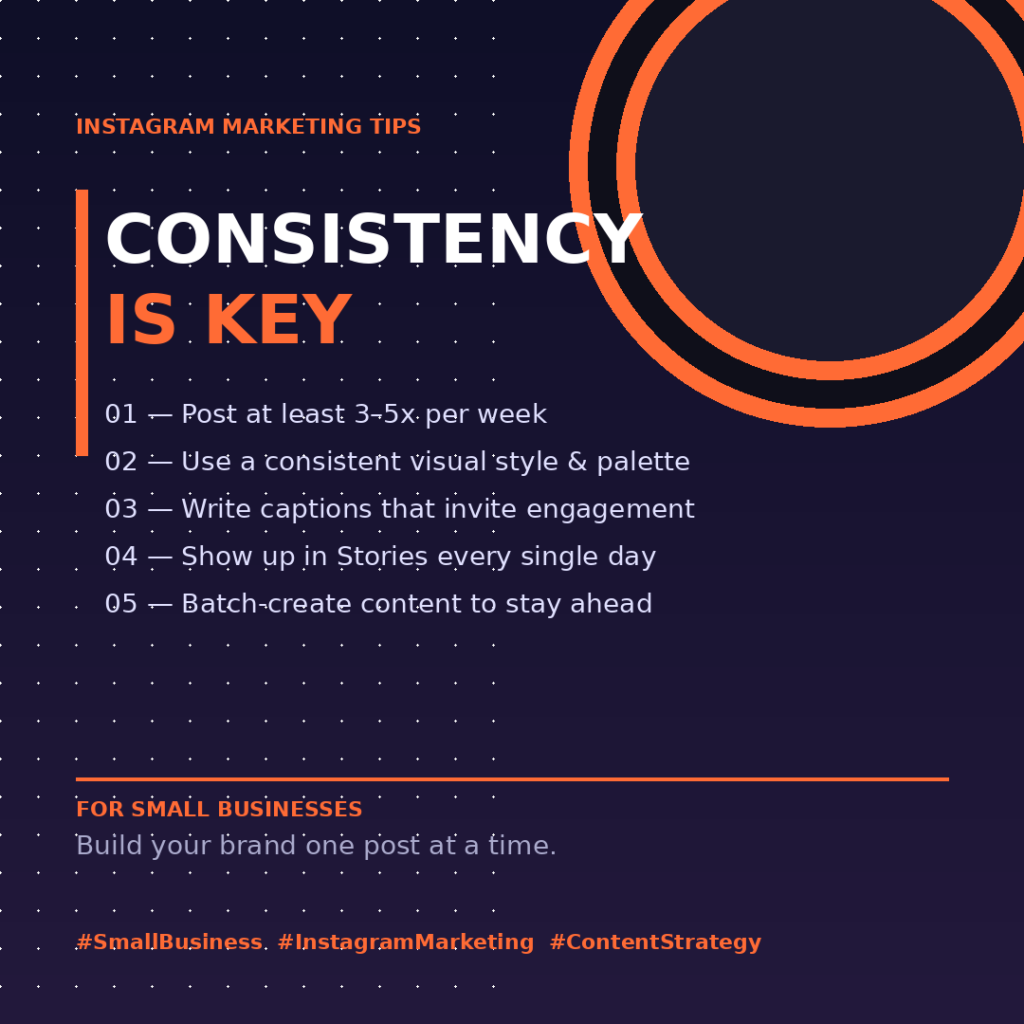
Consistency matters a lot. Instagram rewards accounts that show up regularly. You don't need to post every single day, but disappearing for three weeks and then posting ten times in a row confuses the algorithm and your followers. A steady rhythm — even just three or four posts a week — outperforms sporadic bursts.
And here's something people forget: Instagram tracks how often you engage with other accounts too. If you reply to comments, respond to DMs, and interact with posts in your niche, the algorithm sees you as an active participant in the community. That boosts your visibility.
Reels Are Your Biggest Growth Lever — Here's How to Use Them
Let's be honest about something. If you're not using Reels, you're leaving the majority of your potential reach on the table.
Reels are the single most powerful way for a small business to reach people who don't already follow you. They appear in the Explore page, in users' Reels feeds, and even in the regular feed. Your regular posts mostly reach people who already follow you. Reels can reach completely new audiences.
Here's an example. Imagine you own a small plant shop. You post a photo of a new succulent you just got in stock. About 200 of your followers see it. Now imagine you post a 30-second Reel showing "5 plants that are impossible to kill" with a fun trending audio clip. That same Reel might reach 5,000 people — most of whom have never heard of your shop. That's the difference.
You do not need fancy equipment. The best-performing small business Reels are often filmed on a regular smartphone in natural light. What matters is that the content is clear, interesting, and starts strong.
The first three seconds of your Reel are everything. Half of your potential viewers will scroll away before the three-second mark if you don't hook them immediately. Start with a question, a surprising statement, or jump straight into the action. Never start a Reel with a logo intro or "Hey guys welcome back." That's an instant scroll-away.
Here are some Reel ideas that consistently work for small businesses. Behind-the-scenes content — show how your product is made, how you package orders, what a typical day in your business looks like. People love seeing the process. It builds trust and makes your brand feel real. How-to videos — teach your audience something useful related to your product. A bakery might show how to store sourdough properly. A skincare brand might share a proper cleansing routine. A bookshop might show how to organize a bookshelf by color. Educational content gets saved and shared, which the algorithm loves. Before-and-after content — if your product or service creates a visible transformation, show it. A house cleaner, a hairsalon, a landscaping business, a tailor — all of these have natural before-and-after stories waiting to be told. Customer story Reels — with permission, share a customer's experience. Even a simple screenshot of a glowing review with a short video can be incredibly persuasive for new visitors.
Use trending audio when it makes sense. Instagram actively promotes Reels with popular audio, so using a trending sound gives your content an extra push. You don't have to dance or do anything cringey. Plenty of trending sounds are just popular background music. Tap the music icon when creating a Reel and look for the upward-pointing arrow next to a track — that means it's currently trending.
Aim for 3 to 4 Reels per week if you can manage it. If that's too much, even one or two good Reels a week will outperform posting random grid photos every day to use Instagram Marketing Tips for Small Businesses.
Instagram Stories — Your Secret Weapon for Building Loyalty
While Reels help you reach new people, Stories are how you build deep loyalty with the people who already follow you.
Stories disappear after 24 hours. This actually works in your favor, because it creates a low-stakes, authentic space. You don't need a perfect photo or a carefully written caption. Stories are where your audience gets to see the real, day-to-day side of your business.
Post Stories every day if you can. Even just one or two. Show what you're working on today. Share a quick tip. Post a poll asking your audience a fun question. Show something from behind the scenes. The goal is just to stay at the front of their mind so when they're ready to buy, they think of you first.
The interactive features in Stories are incredibly powerful. Polls, question stickers, quiz stickers, and slider reactions all get your audience to actively engage with your content instead of passively watching. Ask "Which product should we launch next?" and let your followers vote. Use the question sticker and say "Ask me anything about [your product]." These interactions don't just build connection — they give you incredible insight into what your customers actually want.
Use Story highlights to save your best Stories permanently. Create categories like "About Us," "Reviews," "Products," "Behind the Scenes," and keep adding to them. When new visitors land on your profile, your highlights give them a quick window into who you are and what you offer.
How to Write Instagram Captions That Actually Work
A lot of people treat their Instagram caption as an afterthought. They post a great photo and then type "loving this 😊" and wonder why nobody engages.
Your caption is where the connection happens. A great photo stops the scroll. The caption keeps them there and drives action.
Start with a hook. The first line of your caption is the only thing most people see before they have to tap "more." Make it count. A question works great: "Have you ever bought a plant that died within a week?" A bold statement also works: "Most small businesses are wasting money on ads they don't need." A relatable opener is another good approach: "Running a business from your kitchen table is not glamorous. But here's what we've learned." Whatever you choose, the first line should make someone want to read more.
After your hook, deliver the value. Tell a story, share useful information, explain what makes your product special, or let them in on something personal about your business. Keep your sentences short and your paragraphs to just one or two lines. Long walls of text feel like homework. Short, punchy paragraphs feel like a conversation.
Always end with a clear call to action. Tell people exactly what you want them to do next. "Save this for later." "Drop a comment below and tell me your favorite." "Click the link in bio to shop the collection." "Tag a friend who needs this." People need a nudge. Give them one.
And use keywords in your captions. Write the words your ideal customer would type into a search bar. If you sell handmade jewelry in Brooklyn, phrases like "handmade jewelry Brooklyn" or "unique gifts for her" in your caption help Instagram understand who should see your content.
In Instagram Marketing Tips for Small Businesses The Role Of Hashtags in 2026 — Less Is More
Here's something that surprises a lot of people. Using 30 hashtags on every post is not just outdated — it can actually hurt your reach.
Instagram's algorithm in 2026 is smart enough to understand what your content is about without needing a wall of hashtags to figure it out. Stuffing your caption with generic tags like #love, #instagood, or #photooftheday signals to the algorithm that you're trying to game the system rather than create genuine content.
The current best practice is to use 3 to 5 well-chosen, relevant hashtags. Quality over quantity, every single time.
Here's how to pick the right ones. Be specific, not broad. A coffee shop should use #austincoffee or #austincoffeeshop instead of just #coffee. The broader the hashtag, the more competition you have and the less likely your content is to be seen by the right people. Use niche hashtags where your ideal customer is actually spending time. Use a location hashtag if you're a local business — #chicagoboutique or #seattleflorist genuinely help nearby customers discover you. Create a branded hashtag for your business and encourage customers to use it when they share photos of your products. Over time this becomes a free gallery of user-generated content.
And always add a location tag to your posts. Tag your city, your neighborhood, or your specific venue. This helps you show up in local searches, which are incredibly valuable for brick-and-mortar businesses.
Instagram Shopping — Turn Your Profile Into a Store
If you sell physical products, Instagram Shopping is something you absolutely need to set up. It allows people to tap directly on a product in your photo or Reel, see the price and description, and buy it without ever leaving Instagram.
This removes a massive amount of friction from the buying journey. Instead of someone seeing your product, thinking "I might buy that," and then forgetting about it by the time they get to your website — they can just tap and buy right there in the moment.
Setting it up takes a bit of work upfront — you'll need to connect your product catalog through Facebook Commerce Manager — but once it's live, it runs itself. Tag your products in every relevant post and Reel. Add product stickers to your Stories. Create a Shop tab on your profile so visitors can browse your full collection.
Even if you don't complete a sale inside the app, the product tags help interested customers get to your website faster. Every click on a product tag is a warm lead.
Work With Micro-Influencers to Reach New Audiences With Instagram Marketing Tips for Small Businesses
You don't need to pay a celebrity to get influencer marketing results. In fact, for most small businesses, working with a mega-influencer would be a waste of money.
Micro-influencers — accounts with between 5,000 and 50,000 followers — consistently deliver better results for small businesses. Their audiences are smaller but far more engaged. Their followers actually trust their recommendations because they feel like they know them personally. And partnering with a micro-influencer in your local area or niche is usually much more affordable.
Think about who your ideal customer follows on Instagram. Then look for creators in that same space. If you run a yoga studio, look for local fitness and wellness influencers. If you sell artisan cheese, look for food bloggers in your city. A quick DM offering a free product or a small fee in exchange for an honest post can open doors.
The key is authenticity. Don't give them a script. Let them create content in their own voice. Audiences can smell a forced, scripted promotion from a mile away. Give them your product, let them experience it genuinely, and let them share what they think. That authenticity is exactly what makes micro-influencer marketing work.
Post at the Right Time — But Don't Obsess Over It
Timing does matter on Instagram. Posts that get strong engagement in the first hour tend to get pushed to more people. So posting when your audience is actually awake and active gives you a head start.
Generally speaking, the best times to post are Tuesday to Friday mornings between 9am and 11am, and Tuesday to Thursday evenings between 6pm and 9pm. Weekday lunch hours are another solid window. Weekends tend to have lower engagement for business content.
But here's the thing — these are averages across millions of accounts. Your specific audience might behave differently. The only way to know for sure is to check your Instagram Insights. Go to your profile, tap the Insights button, and look at when your followers are most active. That data is specific to your audience and far more accurate than any generic "best time to post" guide.
Use a scheduling tool like Buffer, Later, or Meta Business Suite to schedule your posts in advance. This means you're not scrambling to post at 9am every morning. You batch your content once a week, schedule everything, and then show up only for engagement — replying to comments and DMs.
In Instagram Marketing Tips for Small Businesses Engage With Your Audience Every Single Day
Here's a truth that a lot of social media advice ignores. Posting great content is only half the battle. The other half is showing up as a real human who interacts with people.
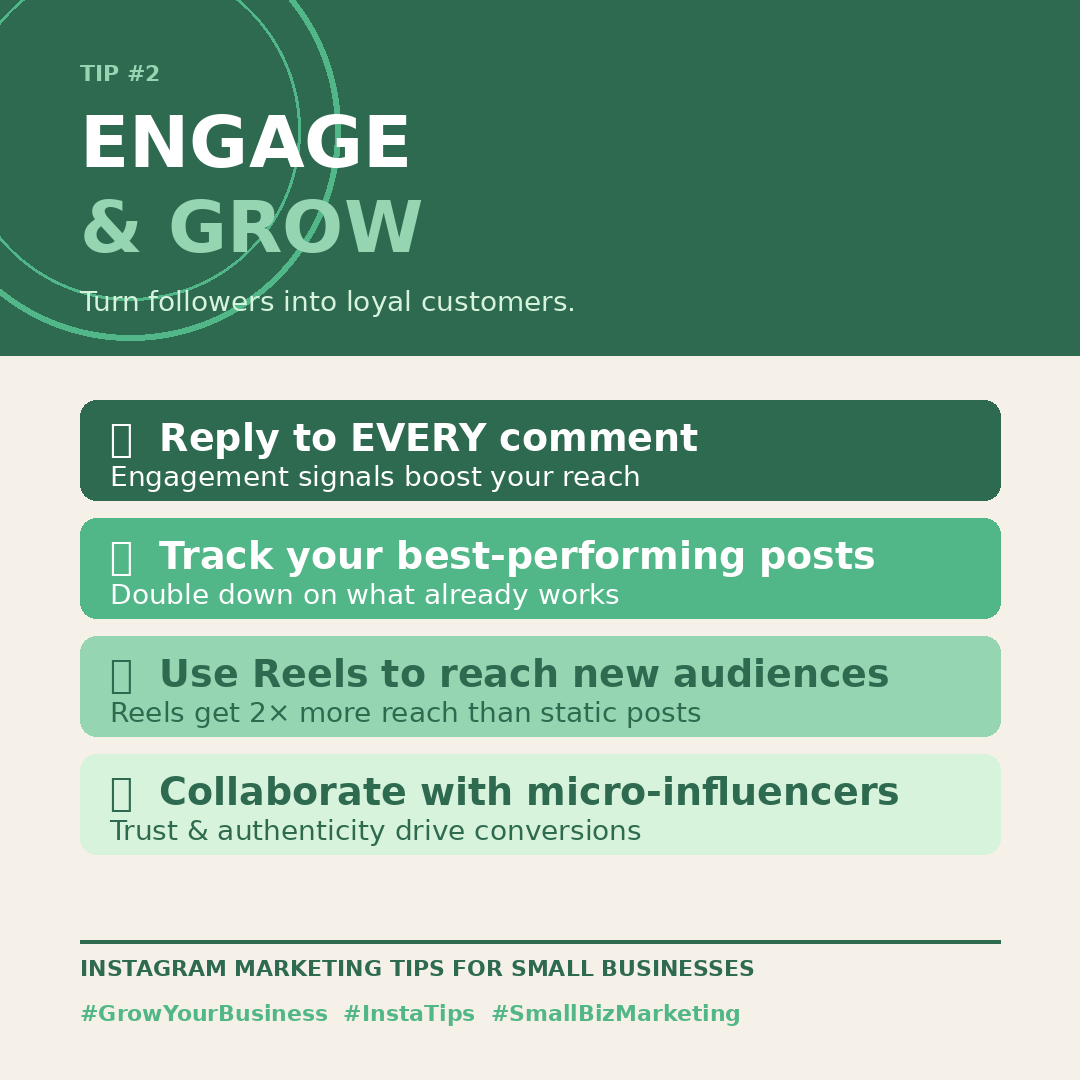
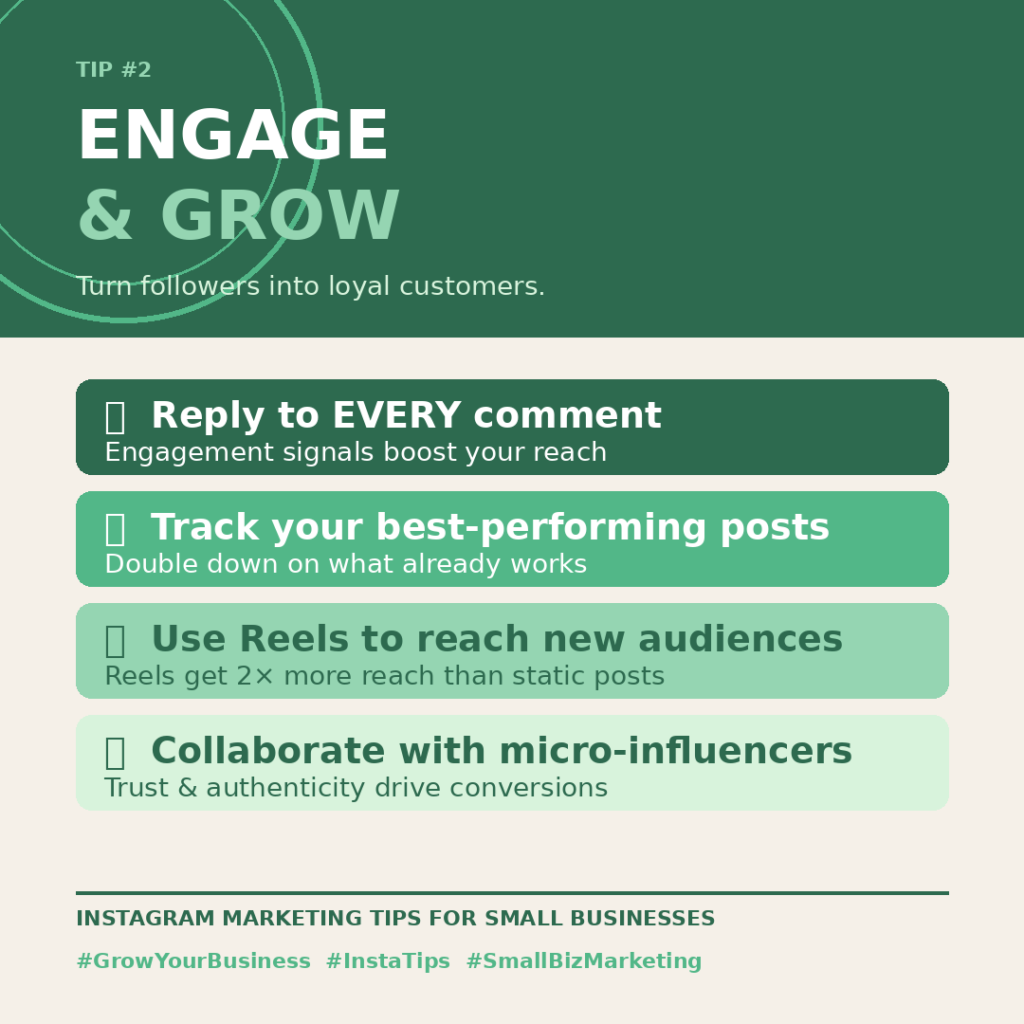
Reply to every comment you receive. Every single one, especially when you're smaller. Even a simple "Thank you so much! 😊" is better than silence. People notice when a brand responds. It makes them feel valued and makes them more likely to comment again.
Reply to Story mentions and DMs. When a customer posts a photo of your product and tags you in their Story, respond to it. Thank them. Share it to your own Stories with their permission. These small moments of connection create loyal customers who become your biggest advocates.
Engage with other accounts in your niche too. Leave genuine, thoughtful comments on posts from accounts your ideal customer follows. Not "Great post! Check out my page." but something that actually adds to the conversation. This gets your name in front of new audiences and builds real relationships in your community.
The more you engage, the more the algorithm reads you as an active, trusted member of the Instagram community — and the more it boosts your content.
Measure What's Working and Drop What Isn't
You can't improve what you don't look at. Instagram Insights gives you free access to data that would have cost small businesses a fortune just a few years ago. Use it.
Every week, spend 10 to 15 minutes looking at your numbers. Which posts got the most saves? Which Reels got the most shares? Which Stories had the highest tap-through rate? Which post brought the most profile visits? These numbers tell you what your audience actually wants, not what you think they want.
Key metrics to pay attention to: reach (how many different accounts saw your content), saves (a strong signal of valuable content), shares (how often people sent your post to someone else), profile visits from a specific post (a sign that the post made people curious about your brand), and website clicks (your ultimate conversion metric).
Look for patterns over 4 to 6 weeks. Maybe your behind-the-scenes Reels always outperform your product shots. Maybe your Tuesday posts always get more engagement than your Friday posts. Maybe your longer captions with personal stories get twice as many saves as your shorter ones. Once you spot a pattern, lean into it.
The goal isn't to go viral once. It's to build a consistent strategy that grows your audience and revenue steadily over time. Data is how you do that.
Common Instagram Mistakes Small Businesses Make (and How to Avoid Them) Without Instagram Marketing Tips for Small Businesses
Let's close with the things that quietly kill small business Instagram accounts. Knowing what not to do is just as valuable as knowing what to do.
Posting only promotional content is the biggest mistake. If every post is "Buy this" or "Sale on now," people stop following you. They feel like they're on a mailing list, not following someone they like. Aim for the 80/20 rule — 80% of your content should educate, entertain, or inspire. Only 20% should be a direct sales pitch.
Ignoring comments and DMs tells your audience you don't care about them. Even if you're busy, set aside 15 minutes a day to reply to people. It makes a bigger difference than you'd expect.
Buying followers is a trap. Fake followers don't buy your products. They don't share your posts. They drag your engagement rate into the floor, which makes the algorithm show your content to fewer real people. Organic growth is slower but it's the only kind that actually builds a business.
Copying your TikTok videos directly to Instagram is something to avoid. If your Reel has a TikTok watermark, Instagram's algorithm will actively reduce its reach. Re-record your content natively in Instagram, or use a watermark removal tool and add something unique to the video.
Posting inconsistently is one of the most common and damaging habits. Posting ten times in one week and then going silent for a month confuses your followers and the algorithm. Pick a realistic posting schedule — even just three times a week — and stick to it.
Finally, not having a clear call to action in your posts and Stories means you're letting warm interest go cold. Always tell people what you want them to do next. Save this. Share this. Click the link. Book now. Follow for more. One clear direction is all it takes.
Final Thoughts — Instagram Is a Long Game, But It Pays Off
Here's the realistic picture of Instagram Marketing Tips for Small Businesses. You're probably not going to post one Reel and wake up the next morning to 10,000 new followers and a flooded inbox. That's not how this works for most small businesses.
What does happen — when you show up consistently, create genuinely useful content, engage with your audience like a real human, and keep learning from your data — is steady, compounding growth. Your audience gets bigger. Your posts reach more people. More people discover your business. More people buy.
Instagram is not a quick fix. But it is one of the most cost-effective marketing channels available to a small business in 2026. You don't need a big budget. You don't need a marketing team. You don't need to be a professional photographer or video editor.
You just need to show up, be authentic, create content that helps or entertains your ideal customer, and be consistent. Do that for 90 days and you will see results. Do it for a year and Instagram can become one of your most reliable sources of new customers.
Start with one thing from this guide today. Set up your bio. Film your first Reel. Reply to a comment you've been ignoring. Small steps, done consistently, build real businesses.
Disclosure: This post contains general marketing advice for educational purposes. Results may vary based on your industry, audience, and consistency of execution.
Read: Instagram marketing for small business: A strategic guide to sustainable growth